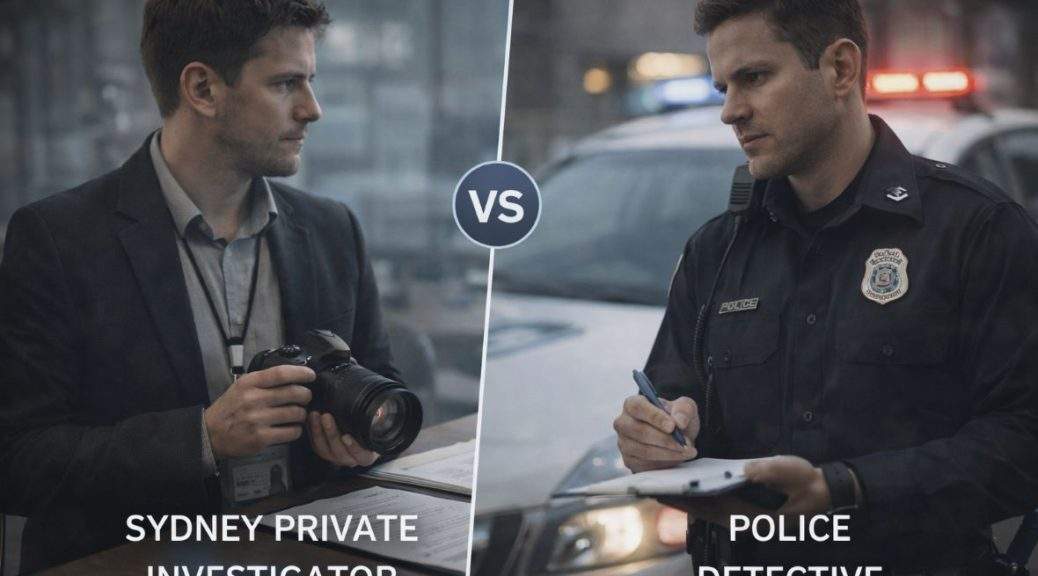
Have you ever needed to uncover a difficult truth in Sydney, maybe about a partner, a workplace issue, or a disputed set of facts? The first question is usually the same: do you call the police or hire a private investigator?
Here is the clean way to think about it.
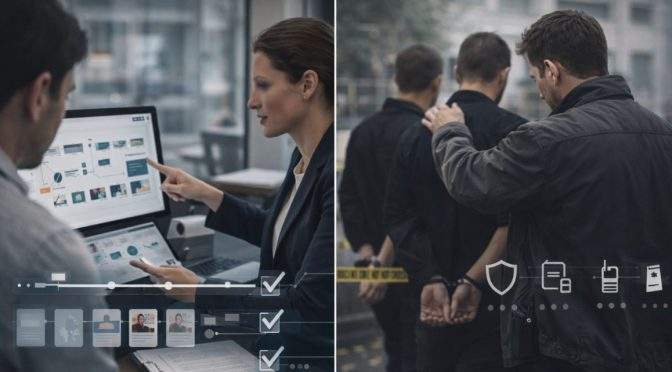
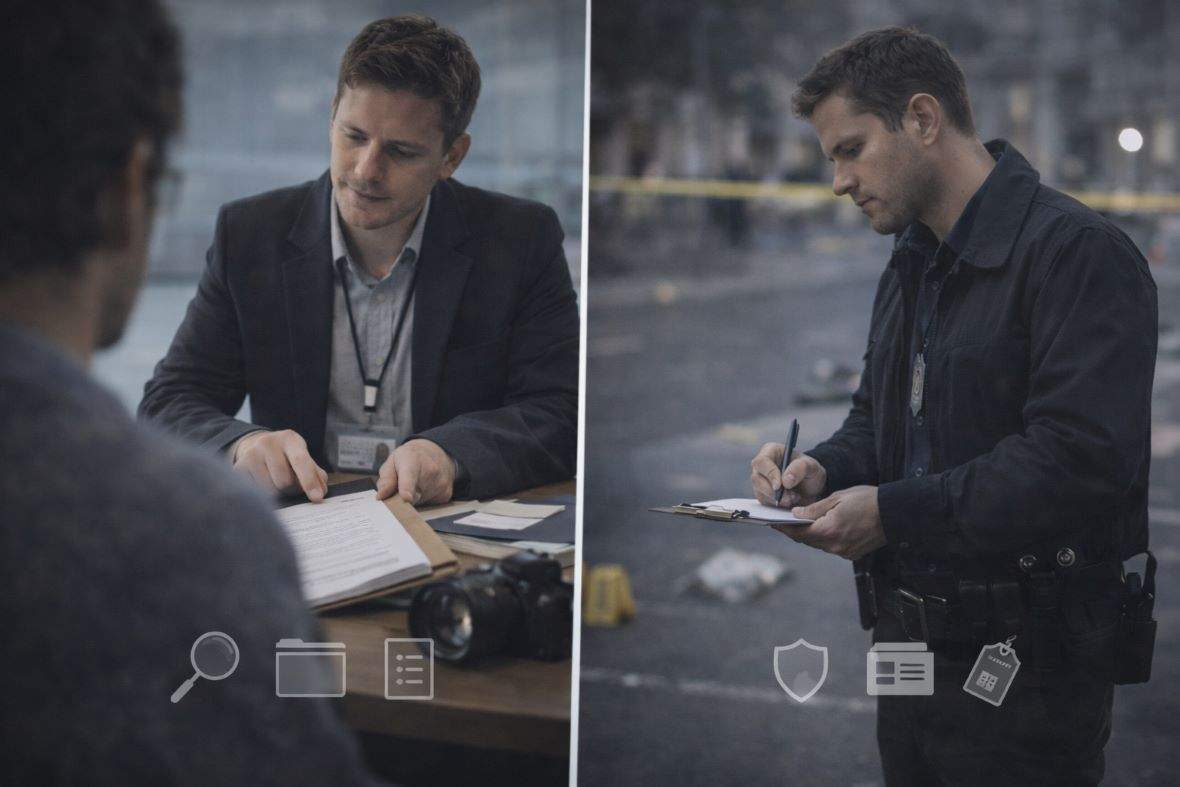
Police detectives investigate suspected crimes and enforce criminal law on behalf of the public. They can use powers the law reserves for the police, such as arrests and warrants.
A Sydney private investigator gathers information for a private client, usually for civil, personal, or business matters, and must work within the limits of an ordinary citizen, plus strict licensing rules.
Understanding the Legal Authority of Police vs. Private Investigators
1) Legal authority: what the police can do that a PI cannot
Police detectives (state authority)
NSW Police are established under the Police Act 1990 (NSW) and exercise powers given by law.
In practice, that means police can:
-
arrest without warrant in defined circumstances (LEPRA s 99)
-
apply for and execute warrants for search and seizure (LEPRA Part 5)
-
access to policing systems and specialist capabilities, including forensic and technical services
Police can also seek lawful access to telecommunications through warrant-based pathways under Commonwealth law. The Home Affairs overview explains that agencies can only obtain interception or access warrants for the national security or law enforcement purposes set out in the Telecommunications (Interception and Access) Act 1979.
Private investigators (licensed private service, no special powers)
A private investigator in NSW must be properly licensed (Class 2E) and meet training requirements under NSW Police SLED.
The Security Industry Act 1997 (NSW) defines a “private investigator” as someone engaged to investigate a person’s affairs or conduct surveillance of a person on behalf of someone else.
A PI cannot:
-
force entry, search property, or seize items
-
compel someone to answer questions
-
pretend to be police, or use police-only methods like interception warrants
-
hack accounts or bypass privacy settings
2) Tools and access: why police investigations look different
Police have access to specialist forensic and technical resources that private investigators do not. NSW Police’s Forensic Evidence and Technical Services Command (FETSC) provides forensic and technical services to support investigations and the justice system.
A private investigator’s “toolkit” is different. It is built around lawful observation, documentation, open-source research, and client-provided material. The Australian Institute of Criminology’s research on the PI industry notes that private investigators provide a wide range of services to clients, and that these services are widely used by insurers and legal firms.
3) Surveillance and privacy limits: where PIs must stop
A Sydney PI can usually observe and document activity in public, from a lawful vantage point. The problems begin when someone tries to “upgrade” a PI into a covert operator.
Audio recording and bugs
In NSW, surveillance device laws regulate listening devices and private conversations. The Surveillance Devices Act 2007 (NSW) is the core statute, and AustLII summarises that the Act includes prohibitions around listening devices and tracking devices.
Practical takeaway: if a client asks for a hidden audio recording, a reputable PI will push back hard and keep the case lawful.
GPS trackers
Tracking devices are also regulated under the same NSW Act. A “just track the car” approach can create legal exposure fast.
Workplace investigations
Workplace surveillance has additional rules in NSW. The Workplace Surveillance Act 2005 (NSW) includes requirements such as prior notice for surveillance, with specific requirements for different surveillance types.
This matters for employer investigations, misconduct matters, and internal leak cases.
Hacking and private accounts
A private investigator cannot hack into email, social media, or devices. The Commonwealth Director of Public Prosecutions lists key cybercrime offences and points directly to Criminal Code provisions like s 478.1 (unauthorised access to, or modification of, restricted data).
4) Evidence: what is “usable” versus “just interesting”
People often assume that if something is true, a court will accept it. Courts look at more than the truth. They look at how it was obtained and whether it is fair to use.
In NSW, Evidence Act principles include a discretion to exclude improperly or illegally obtained evidence (s 138). That means even “real” material can become a problem if it was gathered unlawfully.
This is one reason licensed investigators document carefully and avoid shortcuts.
5) When to call the police vs when to hire a private investigator
A simple way to decide is to ask: Is this primarily a criminal matter requiring police powers, or a private fact-finding problem?
| Situation | Best first call | Why |
|---|---|---|
| Immediate danger, violence, threats | Police | Urgent safety response and criminal enforcement powers (LEPRA). |
| Burglary, assault, serious fraud | Police | Crime investigation, warrants, arrests, forensics. |
| Relationship infidelity, pattern confirmation | Private investigator | Private fact-finding, lawful observation, client-focused reporting. |
| Workplace misconduct or information leak | Often PI plus legal advice | Evidence gathering within the workplace and privacy rules. |
| “Find a person” (non-urgent, civil) | Private investigator | Time and focus for skip-tracing-style enquiries. |
Speed and Dedicated Resources for Your Case
Police detectives and private investigators both investigate, but they do it for different reasons and with very different legal powers. Police act on behalf of the public and can use warrants, arrests, and forensic methods when criminal thresholds are met.
A Sydney private investigator acts for a client, must be licensed, and must stay inside surveillance, workplace, and cybercrime boundaries.
If you choose the right professional for the right job, you reduce risk and improve the chance that your information is both reliable and usable.
Conclusion
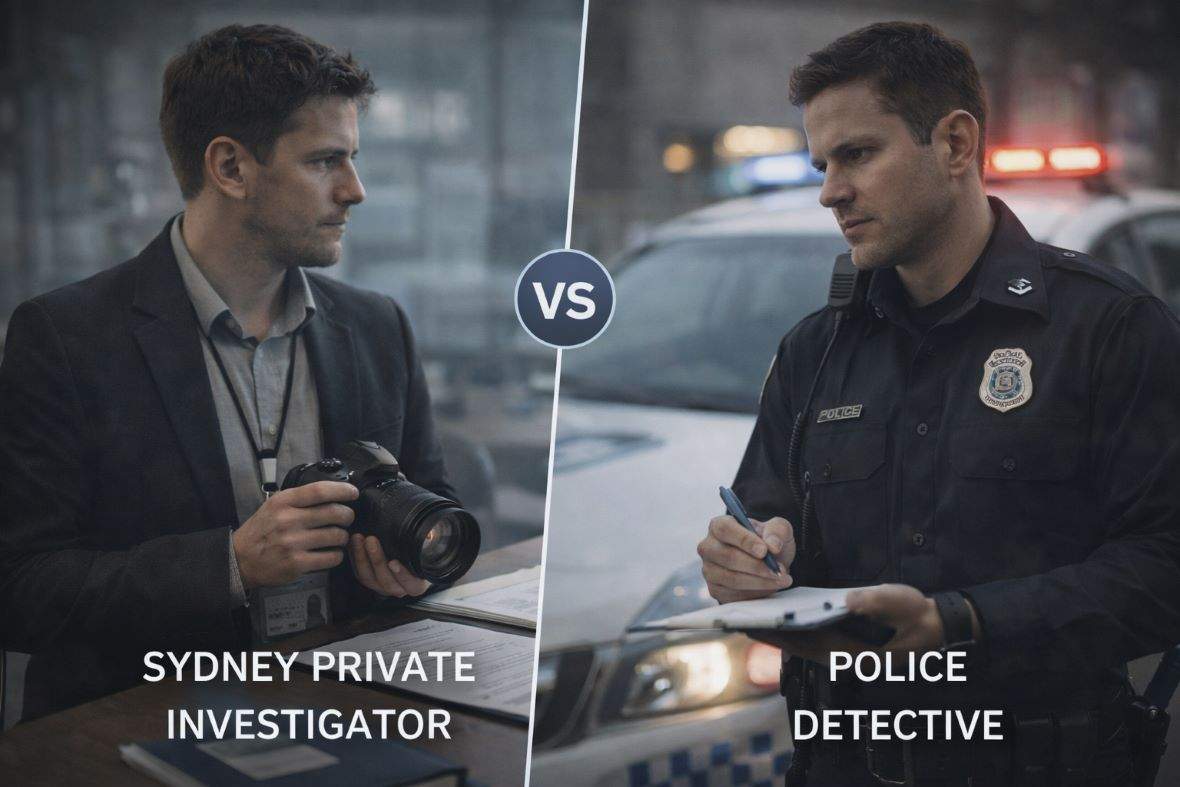
Police detectives and private investigators both investigate, but they do it for different reasons and with very different legal powers. Police act on behalf of the public and can use warrants, arrests, and forensic methods when criminal thresholds are met.
A Sydney private investigator acts for a client, must be licensed, and must stay inside surveillance, workplace, and cybercrime boundaries.
If you choose the right professional for the right job, you reduce risk and improve the chance that your information is both reliable and usable.
Common Questions About Investigators and Detectives in NSW
People often mix up the roles because both jobs involve investigative work. Clarifying a few common points can save time and confusion when you need help quickly. Hiring the right person depends entirely on what you need the final outcome to be.
- Can a PI arrest someone? No, a private investigator in Sydney has no power of arrest. That authority remains strictly with sworn police officers. If a PI witnesses a crime, they must call the police immediately. The PI’s role is evidence collection, never apprehension.
- Is PI evidence legal in Sydney courts? Yes, it is often strong in New South Wales courts. The critical factor is the legality of the gathering. If the Sydney Private Investigator obtained evidence (such as surveillance footage) by remaining on public property and respecting privacy laws, it is perfectly admissible in civil, family, or employment tribunals.
- Does the police investigate cheating? No. The police do not investigate infidelity or suspected cheating partners. These are matters of personal or civil dispute. They will not conduct surveillance or gather evidence specifically for divorce proceedings. That is the function of a private firm.
Choosing the right professional can significantly increase your case’s success rate. Justice for a crime requires the badge, but finding the hidden truth for a business or family matter usually requires the specialised skills of a private agent.
References
Australian Institute of Criminology. (n.d.). Private investigators in Australia. Retrieved March 2, 2026, from https://www.aic.gov.au/crg/reports/crg-1599-00
Australian Institute of Criminology. (n.d.). Private investigators in Australia: Work, law, ethics and regulation (Final report) (PDF). Retrieved March 2, 2026, from https://www.aic.gov.au/sites/default/files/2020-10/CRG-15-99-FinalReport.pdf
Australian Government, Department of Home Affairs. (n.d.). Telecommunications interception and surveillance. Retrieved March 2, 2026, from https://www.homeaffairs.gov.au/about-us/our-portfolios/national-security/lawful-access-telecommunications/telecommunications-interception-and-surveillance
Australian Government, Commonwealth Director of Public Prosecutions. (n.d.). Cybercrime. Retrieved March 2, 2026, from https://www.cdpp.gov.au/cybercrime
Civil Aviation Safety Authority. (n.d.). Drone rules. Retrieved March 2, 2026, from https://www.casa.gov.au/knowyourdrone/drone-rules
New South Wales Government. (1990). Police Act 1990 (NSW). NSW Legislation. Retrieved March 2, 2026, from https://legislation.nsw.gov.au/view/whole/html/inforce/current/act-1990-047
New South Wales Government. (1997). Security Industry Act 1997 (NSW). NSW Legislation. Retrieved March 2, 2026, from https://legislation.nsw.gov.au/view/whole/html/inforce/current/act-1997-157
New South Wales Government. (2002). Law Enforcement (Powers and Responsibilities) Act 2002 (NSW). NSW Legislation. Retrieved March 2, 2026, from https://legislation.nsw.gov.au/view/whole/html/inforce/current/act-2002-103
New South Wales Government. (2005). Workplace Surveillance Act 2005 (NSW). NSW Legislation. Retrieved March 2, 2026, from https://legislation.nsw.gov.au/view/whole/html/inforce/current/act-2005-047
New South Wales Government. (2007). Surveillance Devices Act 2007 (NSW). NSW Legislation. Retrieved March 2, 2026, from https://legislation.nsw.gov.au/view/whole/html/inforce/current/act-2007-064
New South Wales Police Force. (n.d.). Class 2 licences (Security Licensing and Enforcement Directorate). Retrieved March 2, 2026, from https://www.police.nsw.gov.au/online_services/sled/security_licences/class_2_licences
New South Wales Police Force. (n.d.). Forensic Evidence and Technical Services Command. Retrieved March 2, 2026, from https://www.police.nsw.gov.au/about_us/organisational_structure/units/forensic_evidence_and_technical_services_command
Parliament of Australia. (n.d.). Criminal Code Act 1995 (Cth). Federal Register of Legislation. Retrieved March 2, 2026, from https://www.legislation.gov.au/Details/C2019C00043