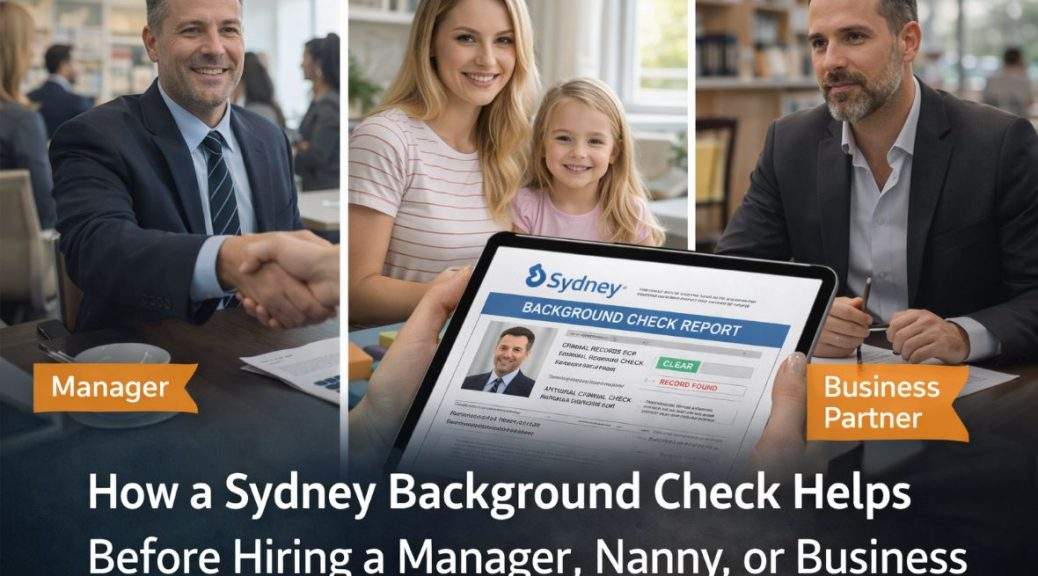
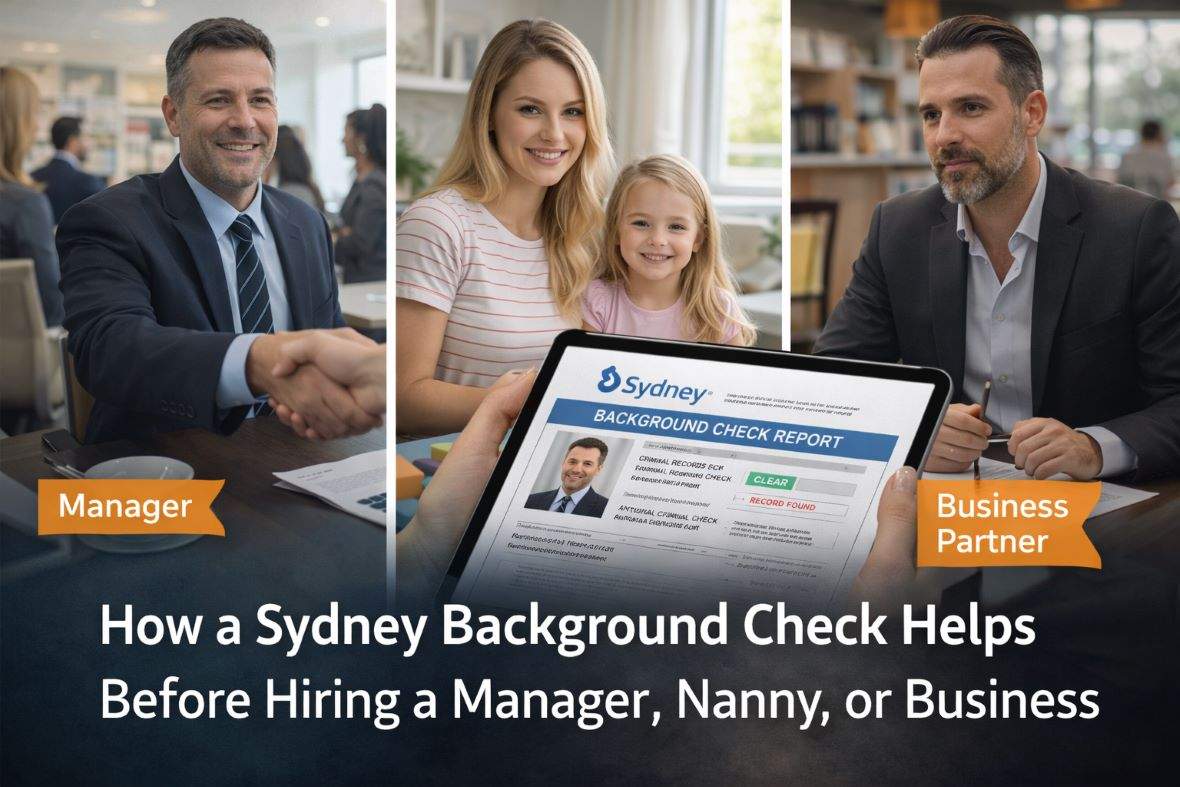
A background check is most useful before trust is given, not after something has already gone wrong. In Sydney, that can mean checking a manager before handing over staff, systems, and budgets; checking a nanny before placing them in child-related work; or checking a business partner before sharing money, liabilities, or decision-making power. The reason timing matters is simple: the right pre-hire or pre-partnership checks can help verify identity, registrations, work rights, and role-relevant risk before access is granted. In NSW, those checks also need to stay within privacy, discrimination, and role-relevance limits. Under the OAIC’s Australian Privacy Principles, organisations may collect personal information only where it is reasonably necessary for their functions or activities, and sensitive information generally requires consent unless an exception applies.
That matters because a “background check” is not one single search. For a nanny in Sydney, the most important issue may be whether the role is child-related work and whether a valid Working with Children Check is required. For a manager, the focus may be employment history, conduct concerns, qualifications, and lawful work status. For a business partner, the priority often shifts to ASIC records, business-name ownership, officeholder history, and whether the person has been banned or disqualified from managing corporations. A strong Sydney background check is therefore role-specific, proportionate, and evidence-based.
A background check should match the risk of the role

One of the biggest mistakes employers and families make is treating every background check as though it should be identical. That approach is inefficient and can also create legal risk. The OAIC’s APP guidance makes it clear that organisations may collect personal information only where it is reasonably necessary for their functions or activities, and that sensitive information generally requires consent. Fair Work also warns that employers cannot take adverse action against a prospective employee for discriminatory reasons. Together, those rules point to a practical principle: check what is relevant to the job or relationship, not whatever is merely available.
In Sydney, that usually means asking three questions first:
- What will this person actually control or access?
- What legal or regulatory obligations attach to the role?
- What facts should be verified before trust is extended?
A manager may have access to staff, payroll, client data, or stock. A nanny may be in child-related work and may also transport children. A business partner may expose you to company liability, director risk, licensing issues, or hidden trading history. The right check depends on those realities, not on a generic template.
Why this matters more than “gut feel”
Hiring and partnership decisions often go wrong because people rely too heavily on impression rather than verification. Research in industrial and organisational psychology has long shown that integrity-related screening and personality-related signals can matter when organisations are trying to reduce the risk of counterproductive behaviour, but the practical lesson is not to over-read a single test. It is to use structured, job-relevant screening rather than instinct alone. That fits the legal position in Australia as well: the collection of sensitive information must be necessary and fair, and criminal-record issues should be assessed against the inherent requirements of the role rather than used as a blunt instrument of exclusion.
The Australian Human Rights Commission’s reasoning in criminal-record cases is especially useful here. It has emphasised that employers should assess whether any criminal record issue is actually connected to the inherent requirements of the particular job, and that a police check alone will often not answer that question without further context. That is one reason a proper background check is more than “tick-box compliance.” It is about making a role-specific decision that is fair, documented, and defensible.
Before hiring a manager in Sydney
Managers create a wider risk footprint than many ordinary hires because they often influence people, money, stock, rosters, systems, supplier relationships, and complaint handling. A Sydney background check for a manager should therefore focus on whether the person is who they say they are, whether their experience and credentials are real, whether they are lawfully able to work, and whether there are any role-relevant warning signs that should be discussed before appointment. Fair Work’s protections against discrimination remain relevant here, so any adverse decision should be tied to legitimate job requirements rather than assumptions or protected attributes.
Useful manager-side checks can include:
- identity verification and employment-history confirmation
- qualification or licence checks where the role requires them
- a National Police Check, where the role justifies it
- work-rights or visa-condition verification, where relevant
- targeted reference checks focused on leadership, conduct, and accountability
- ASIC professional-register checks if the role sits in a licensed or regulated field
For regulated or finance-adjacent roles, ASIC’s professional registers can be especially valuable because they let you search by individual or company name, licence number, ACN, or ABN, and identify whether a person or organisation is registered or licensed to provide certain services. That makes the background check more useful than a resume comparison alone.
Before hiring a nanny in Sydney
For a nanny or any caregiver role that falls within child-related work in NSW, the Working with Children Check is a core issue, not an optional extra. The Office of the Children’s Guardian states that adults who work or volunteer in child-related work in NSW must have a WWCC, and that employers and organisations must verify the WWCC details and keep records. The same source also describes the WWCC as a continuous checking service, which makes it different from a one-off police check.
That distinction matters in practice. A National Police Check can be relevant, but it is a different tool with a different function. Service NSW notes that a National Police Check may be required for employment-related purposes, but for nanny-style roles in NSW the WWCC is the more directly child-safety-focused check where the role qualifies as child-related work. A careful Sydney screening process for a nanny may therefore include:
- verifying the WWCC and keeping the required records
- confirming identity and address details
- checking relevant childcare or first-aid credentials if claimed
- obtaining role-relevant references from families or employers
- asking the candidate to provide their own driving record if the role includes school runs or transporting children
- checking whether an NDIS Worker Check is also required if the role extends into NDIS-funded support work
The child-safety angle is one reason families and agencies in Sydney should avoid casual assumptions such as “they seemed lovely” or “they came recommended by a friend.” A lawful background check does not replace judgment, but it gives judgment something firmer to stand on.
Before taking on a business partner in Sydney
A business partner can expose you to a different kind of risk from either an employee or a nanny. The issue is not simply whether the person is trustworthy in a personal sense. It is whether the trading structure, officeholder history, business-name ownership, licensing status, and company record support the story being told. ASIC provides several official registers that are particularly useful here. Its company and organisation registers allow anyone to search for information about a company or organisation, including basic free details such as the company name, type, ABN or ACN, registration date, next review date, registered-office locality, and a list of documents lodged with ASIC. Paid extracts can provide more detail, including officeholder information.
That means a Sydney business-partner background check should usually go beyond social proof and verbal assurances. It should look at:
- whether the entity is real and current
- whether the business name is actually held by the person or organisation claimed
- whether there is a mismatch between the trading name, ABN, and company record
- whether the person has prior or current officeholder links worth examining
- whether there are lodged ASIC documents that raise concern
- whether the person appears on banned or disqualified registers where relevant
ASIC’s business names register can help identify who holds a business name, and ABN Lookup lets users search by ABN, ACN, or name. Those are practical first steps when a proposed Sydney partner is trading under a name that sounds established but may not be owned by the entity you think you are dealing with.
What a police check can and cannot do
A police check is often useful, but it should not be treated as a complete background check by itself. Service NSW states that a National Police Check can be required for employment and registration purposes, which shows its practical role in hiring. But the Human Rights Commission has also stressed that employers should not assume a police check result automatically decides suitability; the relevant question is whether any issue is connected to the inherent requirements of the role. In other words, a police check can inform the process, but it should not replace the process.
This is especially important for Sydney employers hiring managers and families hiring nannies. A clean police check does not confirm childcare suitability, leadership quality, honesty, or judgment. A non-clean check does not automatically disqualify a person either. What matters is the connection between the information and the actual role, alongside fairness, consent, and lawful handling of the information collected.
Privacy and fairness still matter during screening
A good background check is not just thorough. It is also lawful. The OAIC’s APP guidance says sensitive information generally requires consent and that organisations should collect personal information only where reasonably necessary for their functions or activities. The OAIC also explains that personal information cannot generally be used or disclosed for a new secondary purpose unless an exception applies, such as consent or a legal authorisation.
That means Sydney employers, agencies, and families should be careful about over-collecting information, sharing screening results too widely, or keeping information for reasons unrelated to the original hiring or due-diligence purpose. It also means that “deep digging” is not automatically better. The best screening process is one that is targeted, documented, fair, and linked to the real risks of the role.
How a private investigator can help in Sydney
In some cases, official registers and direct checks are enough. In others, they are only the start. A Sydney private investigator may help when the concern is not just whether a credential exists, but whether the broader story holds together. That can include verifying identity and history gaps, checking whether a claimed business footprint aligns with official records, conducting lawful due-diligence enquiries before a partnership, or helping families and employers organise role-relevant information before a final decision is made. In NSW, that work should still stay within privacy and surveillance limits, and it should complement official checks rather than bypass them.
For Sydney clients, the real benefit is often clarity. A background check is not about proving someone is “good” or “bad.” It is about reducing avoidable uncertainty before you hand over authority, access, money, or care responsibility.
Conclusion
A Sydney background check adds the most value before trust is granted and before the cost of a mistake rises. For a manager, that means verifying experience, work rights, and role-relevant conduct issues before they inherit staff and systems. For a nanny, it means treating child-related screening, especially WWCC verification, as essential rather than optional. For a business partner, it means checking company, business-name, licensing, and officeholder records before signatures and liabilities are shared. The common rule across all three is the same: make the check relevant, lawful, and proportionate. When that happens, a background check stops being a box-ticking exercise and becomes part of a better decision.
FAQs
1. Is a police check enough before hiring a nanny or manager in Sydney?
Usually not on its own. A National Police Check can be useful for employment-related screening, but a nanny role in NSW may also require WWCC verification if it is child-related work, and a manager role may need work-rights, qualification, and role-specific reference checks as well.
2. Can I rely only on a person’s resume before taking on a business partner?
That is risky. ASIC’s registers, the business names register, and ABN Lookup can all help verify whether the entity, business name, and officeholder story match what you have been told.
3. What is the main legal mistake people make with background checks?
A common mistake is collecting or using more information than is reasonably necessary for the role. Under the OAIC’s guidance, sensitive information generally requires consent, and personal information should be used for the purpose it was collected unless an exception applies.
References
Office of the Australian Information Commissioner. Australian Privacy Principles guidelines; Use and disclosure of personal information. (OAIC)
Fair Work Ombudsman. Protection from discrimination at work. (Fair Work Ombudsman)
Office of the Children’s Guardian NSW. Working with Children Check. (Office of the Children’s Guardian)
Service NSW. Apply for a National Police Check; Request a driving record; National Disability Insurance Scheme Worker Check. (Service NSW)
ASIC. Professional registers search; Business names register; Company and organisation registers; Obligations of company officeholders; ASIC disqualifies NSW hospitality director for five years. (ASIC)
ABN Lookup. Search. (ABN Lookup)
Australian Human Rights Commission. AN v ANZ Banking Group Limited [2015] AusHRC 93. (Australian Human Rights Commission)
Sackett, P. R., Burris, L. R., & Callahan, C. (1989). Integrity testing for personnel selection: An update. Personnel Psychology. (Wiley Online Library)