Last updated:
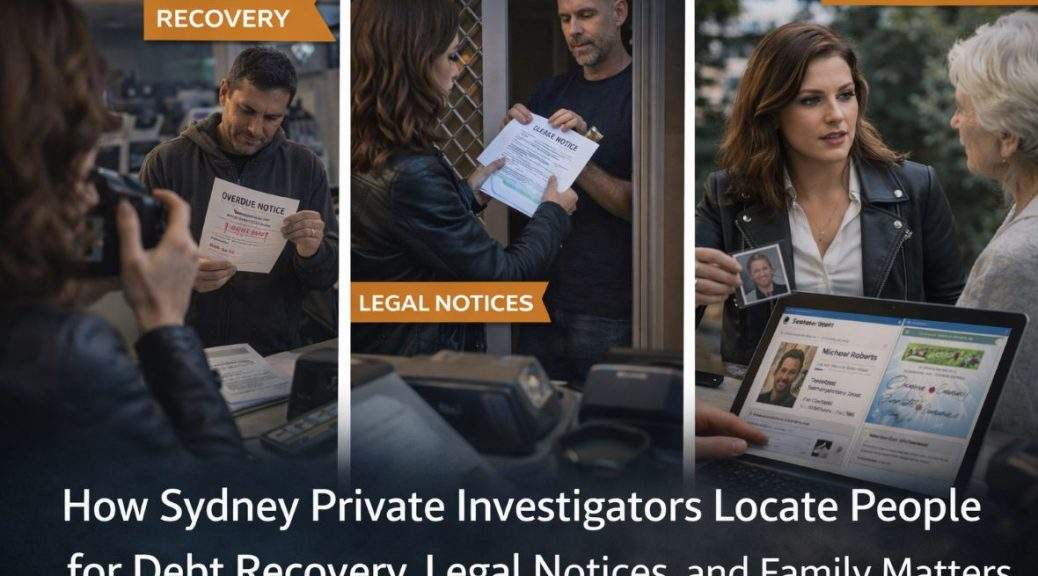
Locating someone in Sydney is usually not about “tracking them down at any cost.” In practical terms, the goal is narrower: confirm a usable contact point, support the lawful service of documents, or verify whether a person can still be reached before the next legal or commercial step is taken. In New South Wales, private investigators operate within a regulated licensing framework, and personal information must still be collected, used, and stored in accordance with privacy rules. NSW Police says Class 2E is the private investigator licence class, while the OAIC says personal information should be collected only where reasonably necessary and used or disclosed only in ways the law permits.
That is why professional location work for debt recovery, legal notices, and family matters tends to be evidence-led rather than dramatic. A good Sydney private investigator helps narrow uncertainty, test whether an address or contact pathway is still valid, and document the result clearly enough for a solicitor, creditor, or client to act on it.
Start with the real objective
The first step is to work out what “locate” actually means in the matter:
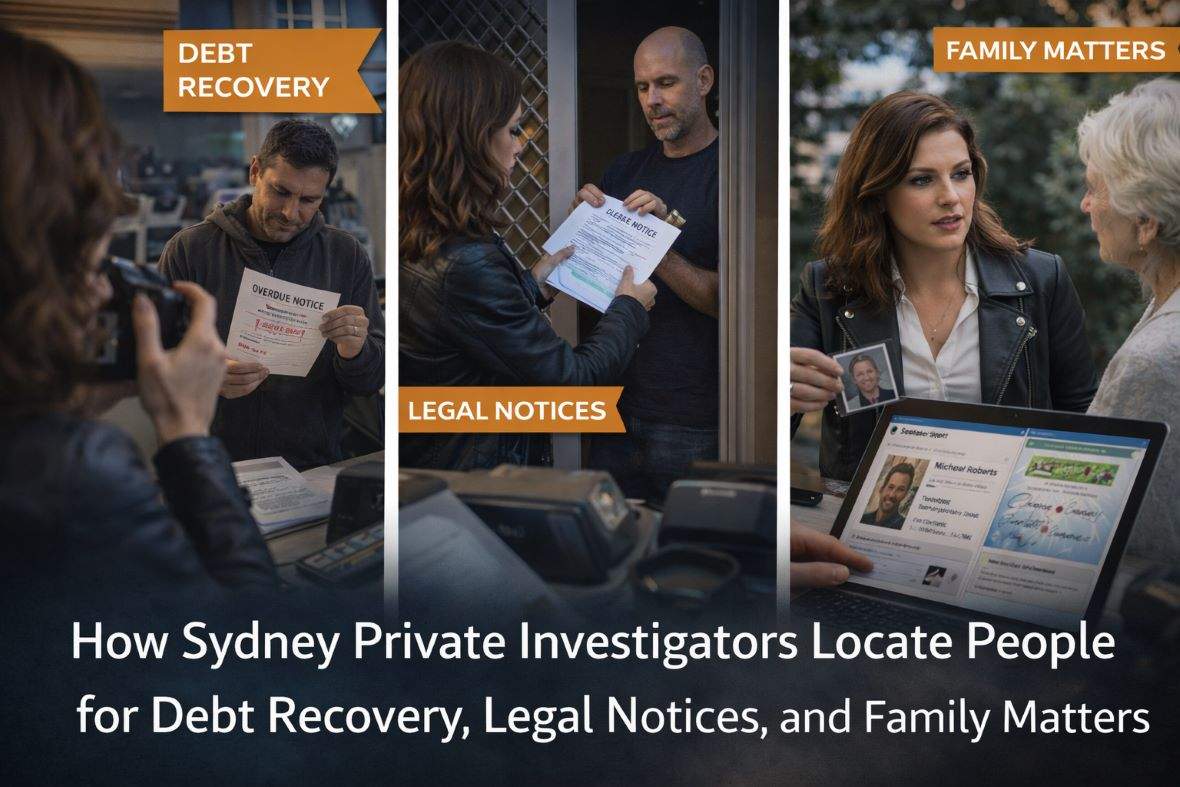
- Debt recovery: confirm whether the person can be contacted lawfully and proportionately
- Legal notices: identify a service pathway that can support proper service or, if needed, an application for substituted service
- Family matters: establish enough evidence of attempted contact or location to move the matter forward without guessing or overreaching
This matters because the legal threshold varies by situation. For debt recovery, the ACCC/ASIC guideline focuses on privacy, limited third-party contact, and restraint. For court matters, the focus shifts to whether service can be proved through an affidavit of service or whether there is enough evidence to justify substituted service.
Debt recovery: lawful tracing, not pressure tactics
For debt recovery matters, a Sydney private investigator usually helps to verify whether a debtor’s address, workplace, or contact details are still current before the creditor or solicitor takes the next step. The ACCC/ASIC debt collection guideline says contact with third parties for location information should be limited and recommends not contacting a third party for location information more than once every six months unless permission for further contact has been given. It also says face-to-face contact should generally be a last resort, although it may be justified to verify identity or location when that is reasonably in doubt.
That means good location work in Sydney is usually built around restraint:
- checking whether the last known address is still active
- verifying whether a business or work contact point is still genuine
- avoiding unnecessary disclosure of the debt to relatives, neighbours, or co-workers
- documenting the attempt carefully instead of turning it into repeated pressure
The value is not just finding a person. It is finding them in a way that does not create a second problem around harassment or privacy.
Legal notices: the real issue is often service
When clients say they need someone “found for legal papers,” the practical issue is usually service. The FCFCOA says that once documents are served, an affidavit of service must be filed to prove service. It also explains that if documents cannot be served in person or by post, a party can apply for substituted service, for example by email, supported by an affidavit explaining why that different method is needed.
That is where a private investigator can add value. The job may be to answer questions like:
- Is the last known address still valid?
- Is there a current workplace or business address linked to the person?
- Is there evidence that ordinary service has failed?
- Is there a more reliable contact pathway that may support substituted service?
This is especially useful because courts care about the quality of the service effort, not just whether someone believes the person is “hard to find.”
Family matters: enough evidence to move the case forward
In family matters, location work is often about helping a case progress rather than producing a residential address for its own sake. The FCFCOA states that if you are applying for substituted service or dispensation of service because you cannot find your spouse, you may need to attend the divorce hearing, and the court may require an affidavit explaining the circumstances. The court also provides family-law service documents, including affidavit-of-service forms, because proof of service is central to the process.
So in family-law tracing, the most valuable output is often:
- a clearer chronology of attempts already made
- confirmation that a last known address is no longer reliable
- evidence supporting an application for substituted service
- organised information a solicitor can use without rebuilding the whole trail from scratch
That makes the work more measured than people expect. It is usually less about “finding where they live” and more about creating a court-usable path to service or next action.
What the investigation usually starts with
A short but useful location brief usually begins with what the client already lawfully knows. Privacy law matters here. The OAIC says an APP entity must collect only the personal information reasonably necessary for its functions or activities, and APP 6 says personal information generally should be used or disclosed only in ways the person would expect or where an exception applies. APP 11 then requires reasonable steps to protect personal information from misuse, interference, loss, and unauthorised access or disclosure.
That means a practical Sydney tracing file usually starts with:
- full name and any previous names
- last known address
- old phone numbers or email addresses
- workplace or business details
- returned mail or failed service attempts
- copies of court documents or notices already issued
- dates of the last known contact
The point is to verify and narrow, not to collect everything possible just because it exists.
What a Sydney private investigator should not do
A legitimate investigator is not there to ignore privacy law or pressure third parties into disclosing information. The regulatory and privacy sources point in the opposite direction: use only what is reasonably necessary, limit disclosure, and handle personal data securely. In debt matters, especially, the ACCC/ASIC guideline warns against over-contacting third parties and against conduct that creates unnecessary privacy harm.
That is why a reputable Sydney investigator should not promise:
- unlimited access to private information
- repeated family or workplace approaches
- public exposure of the person being traced
- shortcuts that would make later service, recovery, or court use harder rather than easier
Conclusion
Sydney private investigators locate people for debt recovery, legal notices, and family matters by doing something more practical than most clients first imagine: they reduce uncertainty to a usable next step. In debt matters, that means lawful, limited tracing that avoids harassment. In legal-notice matters, it means helping identify a service pathway that can be proved properly. In family matters, it often means building enough evidence of attempted contact or failed service to support the next court application. The best location for work is not noisy. It is careful, documented, and lawful enough to stand up when the matter moves from suspicion to action.
FAQs
1. Can a Sydney private investigator contact family members or employers to find someone?
Sometimes, but only carefully and in a limited way. The ACCC/ASIC debt collection guideline says third-party contact for location information should be restricted and not repeated more often than once every six months unless permission for further contact has been given.
2. What if I need to serve documents and cannot find the person?
The FCFCOA says that if documents cannot be served in person or by post, you can apply for substituted service, such as by email, supported by an affidavit explaining why. After service, an affidavit of service is filed to prove it occurred.
3. What should I give a private investigator before asking them to locate someone?
The most useful starting material is usually the last known address, contact details, employer or business information, prior service attempts, and the basic timeline of the matter. That helps keep the inquiry relevant, proportionate, and easier to document.
References
Australian Competition and Consumer Commission. Debt collection guideline for collectors and creditors. (ACCC)
Federal Circuit and Family Court of Australia. Affidavit of service; Forms; Substituted service guidance; Divorce hearing guidance. (Fed Circuit & Family Court of Australia)
New South Wales Police Force. Class 2E private investigator licence requirements. (NSW Police)
Office of the Australian Information Commissioner. APP 3 Collection of solicited personal information; APP 6 Use or disclosure of personal information; APP 11 Security of personal information. (OAIC)

Written by Rob Jones, Senior Investigator at Sydney PI. Rob works on surveillance, background checks and locate cases across Sydney and NSW. Sydney PI is run by GORA Investigations Pty Ltd, NSW Master Licence 412080174.