Not every misconduct complaint in a Sydney workplace requires an external investigator. Some issues can be handled internally first, especially where the facts are clear, the risk is low, and the business already has a workable complaint process. In Australia, there is an important difference between underperformance, ordinary misconduct, and serious misconduct. That distinction matters because the more serious the allegation, the stronger the evidence and process need to be.
A private investigator in Sydney should not be brought in to make a routine HR matter look more serious. A Sydney employer should consider external help when neutrality, timing, lawful evidence-gathering, or the seriousness of the allegation makes internal handling risky. In workplace investigations, problems often arise when the process is unfair, delayed, or handled by someone too close to the issue. That is where an external investigator can add real value.
Start with one practical question: Is this still a management issue, or has it become an evidence issue?

If the concern is ordinary underperformance, poor communication, or a first conduct lapse, the employer should usually begin with standard management processes. But when the issue involves disputed facts, missing evidence, or allegations with serious consequences, it often becomes an evidentiary issue rather than merely a supervisory one.
A Sydney employer should start thinking about an external workplace investigator when:
- staff members are giving conflicting versions of events
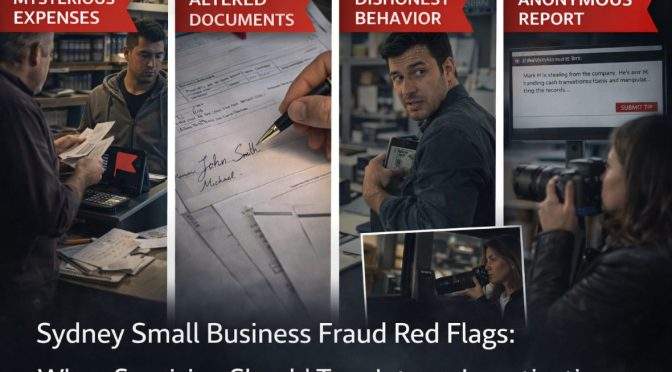
- the allegation involves dishonesty, theft, fraud, harassment, or serious safety breaches
- evidence may be deleted, altered, or lost if action is delayed
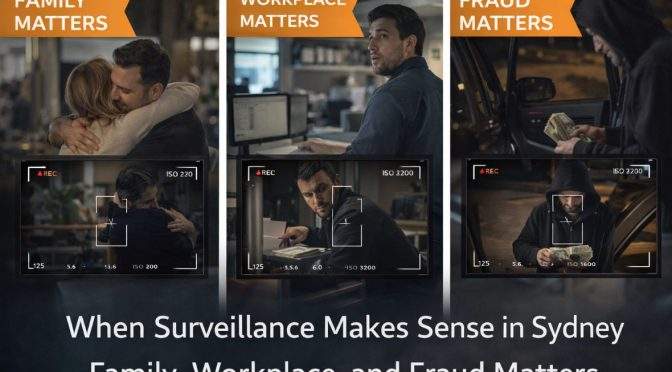
- the conduct happened off-site, after hours, or outside normal supervision
- the accused staff member is senior enough that internal neutrality may be questioned
- the business may later need to justify its decision to Fair Work, insurers, lawyers, or regulators
When a matter reaches that point, the issue is no longer just about managing behaviour. It becomes about proving what happened through a fair and defensible process.
When the facts are disputed and neutrality matters
A Sydney employer should seriously consider hiring a licensed private investigator when there are two or more sharply conflicting accounts and no truly neutral internal decision-maker. This commonly happens in smaller businesses where the owner, director, venue manager, or operations lead is also a witness, complainant, or close working associate of the people involved.
Examples include:
- a Parramatta warehouse supervisor accused of manipulating rosters
- a CBD office manager accused of retaliating after a complaint
- an Inner West hospitality venue dealing with repeated cash discrepancies where staff blame one another
In these cases, the issue is not only what happened. It is also whether the business can later show that the investigation was independent, evidence-based, and not pre-decided.
When the allegation is serious enough that suspicion is not enough
Once the allegation moves into theft, fraud, assault, sexual harassment, deliberate dishonesty, or serious safety breaches, the threshold rises. Serious allegations require stronger evidence. Suspicion, rumour, and workplace gossip are not enough when the possible outcome could be dismissal, insurer involvement, civil recovery, or police referral.
This is often the point where a private investigator is worth considering because they can help:
- establish a reliable timeline
- identify and speak with relevant witnesses
- review available records and incident material
- separate assumptions from verified facts
- preserve evidence before it disappears
That does not replace the employer’s decision-making role. It strengthens the factual basis for that role.
When the conduct happened off-site, after hours, or outside direct supervision
Many workplace misconduct issues in Sydney do not occur neatly within the office. They may involve:
- field staff using company vehicles
- mobile trades teams working across sites
- sales staff meeting clients off-site
- hospitality staff after shifts
- employees interacting in public or digital spaces outside the workplace
In these situations, the employer may need to determine whether off-site conduct still has a genuine connection to employment, safety, property, client relationships, or business interests. A private investigator can be useful when the employer needs lawful verification of movement, attendance, client contact, vehicle use, or repeated behaviour patterns.
The goal should never be to pry into private life for its own sake. The goal is to determine whether the conduct has a real workplace connection and whether that connection can be evidenced properly.
When bullying, harassment, or repeated misconduct patterns are involved
Bullying and harassment complaints do not always need to be outsourced, but they often should be escalated when they are:
- repeated rather than isolated
- strongly contested
- linked to a manager or supervisor
- spread across multiple sites or teams
- supported by partial evidence but not a complete chronology
An external investigator may be especially useful where there are allegations of intimidation, retaliation, or repeated behaviour over time. In those matters, the employer is often trying to build an accurate sequence of events, identify patterns, and distinguish isolated misunderstandings from sustained misconduct.
When evidence may disappear if you wait
Delay is one of the most common reasons workplace investigations become weak. A rushed dismissal is risky, but so is waiting until the available evidence is gone.
A Sydney employer should act quickly to preserve what it already controls lawfully, such as:
- rosters
- incident reports
- timesheets
- swipe-card or access logs
- email records
- POS records
- delivery logs
- CCTV already captured under existing systems
An external investigator can then assess the preserved material properly. That is far more effective than trying to reconstruct the facts after records have changed and witnesses have aligned their stories.
What a private investigator can lawfully do in NSW, and what they cannot
In New South Wales, private investigators operate within a regulated licensing framework. That matters because employers are not simply outsourcing a workplace problem. They are engaging a licensed professional to assist with lawful fact-finding.
A workplace private investigator may be able to assist with:
- witness enquiries
- chronology building
- document review
- lawful public-place observation where appropriate
- background fact-checking relevant to the issue
- preparation of clear evidence-based reports
But there are also clear limits. A reputable investigator should not encourage the use of hidden microphones, unlawful recordings, improvised sting operations, or covert workplace surveillance that breaches NSW law.
Employers need to be careful around:
- secret recordings
- covert surveillance without lawful basis
- hidden cameras in ordinary employee areas
- improper monitoring of private activity
- any step that could make evidence unlawful or unusable later
A good private investigator helps the employer stay inside the law, not test how close they can get to crossing it.
How the investigation should fit the employer’s disciplinary process
Even a strong external investigation does not relieve the employer of the obligation to conduct a fair process. The employer still needs to:
- identify the allegations clearly
- tell the employee what is being alleged
- give the employee a chance to respond
- consider the response properly
- document the decision-making process
- make sure any outcome is proportionate to the facts established
This is important because even where misconduct appears serious, a poor process can still create problems later. A workplace investigator should strengthen procedural fairness, not bypass it.
What this looks like in Sydney in practical terms

For a Sydney employer, the best time to hire a private investigator is usually before the matter becomes a legal or operational mess, but after it is clearly too serious, too disputed, or too sensitive for a casual internal inquiry.
Common examples include:
- unexplained stock loss in a Western Sydney warehouse
- suspected fuel-card or vehicle misuse by mobile staff
- repeated bullying complaints in a CBD office
- cash handling irregularities in hospitality venues
- suspected fraud, false timesheets, or supplier collusion
- intimidation or retaliation after a complaint has been made
The common thread is simple: the employer needs independent facts, not internal impressions.
Conclusion
A Sydney employer should hire a private investigator for a workplace misconduct matter when the issue has moved beyond routine management and into serious, disputed, or high-consequence fact-finding. The clearest indicators are conflicting accounts, possible dishonesty, lack of internal neutrality, off-site conduct, repeated behaviour, or a real risk that evidence will disappear.
Used properly, an external investigator does not replace HR, management, or legal advice. They strengthen the factual foundation on which those decisions must rest.In workplace misconduct matters, that can be the difference between a defensible decision and one that later falls apart under scrutiny.
This article is general information only and is not legal advice.
FAQs
1. Can a Sydney employer hire a private investigator for any staff complaint?
No. Many issues should first be handled through ordinary management or HR processes. External investigation is more appropriate where the matter is serious, disputed, sensitive, or difficult to investigate neutrally in-house.
2. Can a private investigator secretly record employees in NSW?
Not simply because an employer wants more evidence. Surveillance and monitoring in NSW are subject to legal limits, and a reputable investigator should work within those boundaries.
3. If the investigation finds misconduct, can the employer dismiss immediately?
Not automatically. The employer still needs a fair process, including notifying the employee of the allegations and giving them a chance to respond before making a final decision.
References
Fair Work Commission. (2024). Conduct. Unfair dismissals benchbook.
Fair Work Commission. (2025). Mr Stewart Khouri v Coulson Aviation (Australia) Pty Ltd [2025] FWC 2819.
Fair Work Ombudsman. (2011). Small Business Fair Dismissal Code 2011.
Fair Work Ombudsman. (2025). Help with bullying in the workplace.
Fair Work Ombudsman. (2025). Managing performance and warnings.
NSW legislation. (n.d.). Security Industry Act 1997 No 157.
NSW legislation. (n.d.). Surveillance Devices Act 2007 No 64.
NSW legislation. (n.d.). Workplace Surveillance Act 2005 No 47.
NSW Police. (n.d.). CAPI licences / Class 2E private investigator licensing information.
Office of the Australian Information Commissioner. (n.d.). Employment.
Office of the Australian Information Commissioner. (n.d.). Workplace monitoring and surveillance.
SafeWork NSW. (n.d.). Bullying prevention policy and related procedures.