

When you suspect cheating, your mind wants quick answers. It fills gaps with worst-case stories, then replays them at 2 a.m. That’s normal, but it’s not reliable.
The safest goal isn’t to “catch” anyone. It’s to observe patterns, write down facts, and protect your well-being. Strong emotions can bend memory and make small events look huge.
Thinking like a private investigator means staying calm, staying legal, and staying focused on what you can actually confirm. You’re not trying to win an argument; you’re trying to stop guessing so you can decide what happens next.
Think like a private investigator: focus on patterns, not gut feelings
A good investigator doesn’t treat one strange moment as proof. People act oddly for many reasons. Stress, burnout, depression, money worries, and family issues can all change someone’s behaviour.
Instead, the PI mindset is simple: baseline, change, repeat.
Start with your partner’s normal baseline. How did they usually handle their phone, work hours, affection, and spending? Then note what changed, when it started, and whether it repeats. One late night is noise. A repeating “late meeting” on the same day every week is a signal worth tracking.
Also, avoid building a case in your head. Your brain hates uncertainty, so it will try to “solve” it fast. Slow it down with facts. If you want a practical list of common red flags, this guide on warning signs your partner is cheating in Sydney lines up with what many investigators hear from clients.
Suspicion feels urgent, but clarity usually comes from patient notes, not impulsive confrontations.
The behaviour shifts that matter most (and what they can also mean)
Look for changes that don’t match your partner’s usual pattern, while staying open to other explanations.
Phone guarding or passcode changes can mean secrecy, or a new desire for privacy after a work scare. Being unreachable more often can suggest hidden time or a heavier workload. Sudden schedule changes might be covered, or a new project with unpredictable hours.
Emotional distance matters too. Less warmth, less “we/us” talk, and fewer future plans can point to divided attention, but it can also show anxiety or depression. Defensiveness and blame can be a form of guilt, or a feeling of being accused and cornered.
Money shifts can be telling. Unexplained spending, cash withdrawals, hotel charges, gifts, or new subscriptions might connect to an affair, or it could be debt, coping purchases, or a surprise you’d actually like.
Even appearance changes have two sides. A grooming overhaul can signal someone trying to impress another person, or it can be a genuine health kick. Likewise, weird new habits like insisting on doing laundry can hide evidence, or it can be a clumsy attempt to “help more.”
The key is comparison. Don’t compare them to other couples. Compare them to their own baseline.
Build a simple timeline so your brain stops guessing
A timeline turns “something feels off” into something you can test. Keep it short, private, and factual. Think receipts, not a diary.
Here’s a simple format that works:
| Date/time | Stated plan | What happened | What changed | Shared proof you already have |
| Thu 7:30 pm | “Working late” | Home at 11:10 pm | No call back for 3 hours | Joint card: restaurant charge |
Write down the date, time, stated plan, and what actually happened. Add only what you know. If you have lawful access to shared info (joint bills, joint accounts, shared calendar entries), note it. Don’t try to get into private devices or accounts you don’t own.
Over a few weeks, patterns often show themselves. For example, every Thursday is “work late,” then a new expense appears in the same area. Even if it’s innocent, you’ll have clean details for a calm talk.
Store your notes somewhere safe. If you fear backlash, keep them off shared devices.
Gather clues the legal way, without turning into the bad guy

If you cross legal or ethical lines, you can damage your safety and your options later. So keep this rule: use what you can see openly, and check only what you already share.
Don’t hack accounts. Don’t guess passwords. Don’t install spyware. Don’t sneak recordings in private spaces. Don’t trespass. Also, don’t follow someone in a way that crosses the line into stalking. Besides the legal risk, it can escalate conflict fast.
If you feel pulled toward those shortcuts, pause. That urge usually comes from panic, not strategy. Your best protection is calm documentation and clear boundaries.
Use shared information sources you already have access to
Shared financial statements can show patterns without invading privacy. Look for charges that don’t fit the household’s routine, such as frequent restaurant spending, hotel charges, or repeated cash withdrawals. One odd transaction proves nothing, but repeats matter.
If you share a phone plan, you may be able to see summary call or text volume to certain numbers (not message content). Again, look for spikes and repeats, not a single blip.
Agreed, family systems count too. Shared calendars, family scheduling apps, or mutually set-up location-sharing can help confirm timelines. If it wasn’t agreed to or shared, don’t access it.
Public social media is another open window. New friends, flirty comments, sudden privacy shifts, or a stream of “single-style” posts can be relevant. Still, don’t treat online impressions as proof. People perform online for many reasons.
A simple boundary helps: if you wouldn’t feel okay explaining how you got the info, don’t go there.
Watch your own safety, money, and privacy while you observe
If tensions are rising, keep your focus on stability. Choose calm settings for serious talks, and avoid confrontations when either of you is angry or drinking.
Tell a trusted friend what’s going on, especially if you feel unsafe. If there’s intimidation or violence, seek local support right away. Your safety comes first.
Money matters too. If you see major red flags, quietly gather important documents (ID, passports, bank details, insurance info). Consider moving your paycheck to an account in your name if you need financial breathing room. Keep kids out of adult details. They deserve normal routines and reassurance.
Some widely reported surveys suggest infidelity is not rare, which can make suspicion feel “likely.” Still, your situation is personal. Stay grounded in what you can prove, not what statistics might imply.
When your notes point to a real problem: talk, set boundaries, or hire help
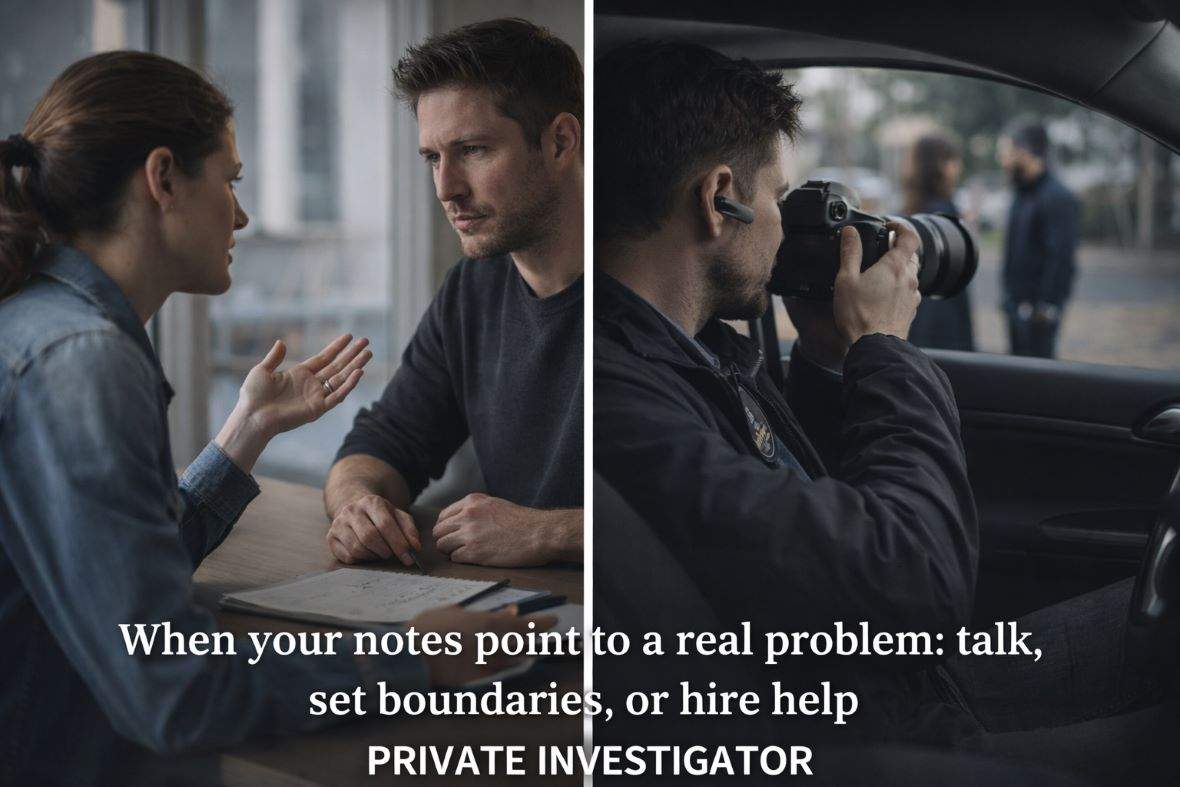
Once you have a few weeks of notes, you’ll usually land in one of three places. The pattern disappears, the pattern continues but has a plausible explanation, or the pattern keeps tightening.
If it’s safe, start with a calm conversation. If trust is breaking down, consider couples counselling. When the stakes are high (divorce, custody, or serious financial issues), you may also want lawful, professional evidence. In that case, a Private investigator in Sydney can gather documentation without putting you in the middle of it. For a clear idea of what lawful surveillance looks like in practice, see how PIs handle infidelity surveillance in Sydney.
How to have the talk without losing control of the fact
Pick a time when you both have space. Keep your tone steady. Use your timeline, not accusations.
Try a script like this: “I want to talk about something hard. I noticed that you’ve been unreachable late on Thursdays, and the plans you share change at the last minute. I also saw two charges we didn’t discuss. Can you help me understand what’s going on?”
Then stop talking. Let silence do some work.
Listen for direct answers versus deflection. Pay attention if the story changes each time, or if you get blame instead of clarity. End with a boundary, not a fight. That might be counselling, mutual transparency, or a temporary separation while you decide.
Facts don’t prevent pain, but they do prevent circular arguments.
What a professional private investigator can do that you should not
A professional can handle lawful surveillance, write clear reports, and document what’s visible in public places. They may also conduct witness inquiries and check certain public records, depending on what’s relevant and legal.
Just as important, they help you avoid mistakes that can backfire. A trained investigator knows how to stay discreet and stay inside the rules. If you want the big-picture view, this page on what Sydney infidelity investigators do explains the typical scope and limits.
Consider professional help when you need clarity to move forward, when there are repeated lies, when you fear escalation, or when legal outcomes may depend on credible documentation.
Conclusion
Seeing like an investigator doesn’t mean becoming cold. It means staying steady when your emotions want to sprint. Focus on patterns, compare changes to your partner’s baseline, and keep a simple timeline that sticks to facts. Stay legal, protect your safety and finances, and avoid actions that could harm you later.
From there, choose your next step: a calm talk, counselling, or professional support if you need clear evidence. Whatever the truth is, you deserve honesty and peace, and you can choose what comes next with a clear head.
Frequently Asked Questions
1) How do I know if I’m seeing real signs of cheating or just anxiety?
Start with a baseline. If the same changes repeat—same day, same excuse, same gaps—those patterns matter more than a single odd moment. Anxiety tends to chase “what ifs.” Patterns show “what is.”
2) What should I write in a timeline, and what should I leave out?
Keep it factual: date/time, stated plan, what happened, what changed, and any shared proof you already have (joint bills, shared calendar). Leave out assumptions, mind-reading, and anything you obtained by crossing privacy boundaries.
3) What can I legally check without invading privacy?
Use only what you already share or can see publicly: joint finances, shared calendars, agreed family apps, and public social media. Avoid private accounts, private devices, hidden recordings, or anything you’d feel uncomfortable explaining later.
4) Is it okay to follow my partner myself to “confirm it”?
It’s risky. DIY surveillance can escalate conflict, cross legal lines, or put you in unsafe situations. It also makes it easier to get noticed, which can shut behaviour down and leave you with more doubt, not less.